Archives for Category Archives: <span>Automation</span>
The 7 biggest mistakes in implementing AI automations
Maria Silva
5 min
Share
Share
Automating with AI seems simple until the system fails in production at 3 in the morning. The truth is that most AI automation projects don’t fail due to a lack of technology, but because of avoidable implementation mistakes. This article maps out the seven most critical ones, analysing the impact of each and offering practical tips to avoid them.
Mistake 1 – Automating without clearly defining the problem
Teams excited about AI frequently jump straight to the solution before deeply understanding the process they want to automate. The result is a technically functional automation that solves the wrong problem — or, worse, creates new problems that didn’t exist before.
Before writing a single line of code, it’s essential to map the current workflow, identify the real bottlenecks and define clear success metrics. Questions like “what exactly do we want to eliminate or optimise?” and “how will we know the automation worked?” need concrete answers before development begins.
Practical tip: Document the “as-is” process before designing the “to-be”. Automation should serve the business, not the other way around.
Mistake 2 – Underestimating data quality and governance
AI models are only as good as the data that feeds them. Organisations that overlook data quality issues — duplicates, format inconsistencies, historical biases, coverage gaps — build automations that amplify those problems at an industrial scale.
An automation pipeline needs a solid data quality strategy before going into production, not after. Without reliable data, no model, however sophisticated, will deliver consistent results.
Practical tip: Invest in data observability from the start. Tools like Great Expectations or dbt tests save hours of future debugging and prevent unpleasant surprises in production.
Mistake 3 – Ignoring the human factor in the transition
Well-designed automations fail when the teams that are supposed to use them resist change or simply don’t understand the new workflow. Implementing AI without a robust change management plan generates parallel workarounds, partial adoption and a gradual erosion of trust in the system.
People need to understand the “why” before embracing the “how”. Teams that feel threatened or excluded from the process tend to undermine — consciously or not — the adoption of new tools.
Practical tip: Involve end users from the discovery phase. They know the exceptions and edge cases that no tech lead or architect will anticipate sitting in a meeting room.
Mistake 4 – Building fragile automations without exception handling
AI systems in production deal with unexpected inputs, unstable APIs and out-of-pattern data far more frequently than test environments suggest. Automations without robust error handling, well-defined fallbacks and proactive alerts fail silently — or worse, execute incorrect actions without anyone noticing until the damage is done.
Resilience is not an implementation detail, it’s an architectural requirement. Every step in the pipeline needs a clearly defined behaviour for failure scenarios, not just for the happy path.
Practical tip: Design for failure from the start. Implement circuit breakers, dead letter queues and retry mechanisms with exponential backoff across all critical integrations.
Mistake 5 – Neglecting security and compliance from the beginning
Automations that handle sensitive data or interact with critical systems need security controls built in by design — not added as a patch after everything is already in production. Issues such as authentication, granular authorisation, action auditing and GDPR compliance are often overlooked in the rush to make things work, creating significant technical debt and regulatory risk.
The cost of fixing security vulnerabilities after deployment is exponentially higher than designing them correctly from the outset.
Practical tip: Adopt a Security by Design approach. Define compliance requirements at the architecture phase and include security reviews as a mandatory step in the development process.
Mistake 6 – Failing to plan for scale and model evolution
An automation that works perfectly for 1,000 records can collapse with 1 million. Beyond volume scale, AI models suffer from model drift over time — the world changes, data patterns change, and a model trained on historical data gradually loses accuracy.
Without strategies for continuous monitoring, periodic retraining and proper model versioning, performance degrades silently until the problem becomes critical and visible to end users.
Practical tip: Implement MLOps practices from the start. Monitor model performance metrics in production — not just business metrics — and define clear thresholds to trigger retraining.
Mistake 7 – Treating AI as a magic and definitive solution
The biggest mistake of all is a mindset one. Teams that see AI as a silver bullet tend to underestimate complexity, ignore the real limitations of models and avoid the iterative work needed for sustainable results. This attitude leads to unrealistic expectations, predictable disappointments and the premature abandonment of initiatives that could have succeeded with the right approach.
AI automation is a continuous process of learning, adjustment and improvement — not a project with a delivery date and an end of story.
Practical tip: Build a culture of responsible experimentation. Define clear MVPs, short feedback cycles and celebrate learnings from controlled failures just as much as you celebrate successes.
Conclusion
Effectively implementing AI automations requires much more than mastering the available technical tools. It takes problem clarity, data maturity, resilient architecture, attention to security and, above all, an organisational culture that understands AI is an iterative partner — not a ready-made answer.
The teams that avoid these seven mistakes are not necessarily the ones with the biggest budgets or the most experienced engineers. They are the ones that ask the right questions before they start building.
If you want to avoid these and other mistakes in your next AI automation initiative, Haipe Studio is ready to help. Book your free consultation today and find out how we can transform your business processes in a safe, scalable way that’s aligned with your real objectives. No commitment, no jargon — just practical solutions designed for your context.
Archives for Category Archives: <span>Automation</span>
Claude vs ChatGPT: Which AI Should Power Your Business Voice Assistant?
Maria Silva
9 min
Share
Share
Every week, a business owner asks us some version of the same question: “Should we use ChatGPT or Claude for our AI agent?”
It’s a fair question. And the honest answer — one that most comparison posts won’t give you — is that they’re built for different things. Choosing the wrong one doesn’t just affect quality. It affects cost, maintenance, and whether your customers actually stick around after talking to your AI.
This isn’t a developer deep-dive. It’s a business-first breakdown of what each AI actually does well, where each one falls short, and how to choose based on what your customers need — not what sounds most impressive in a pitch deck.
First, Let’s Get Clear on What We’re Actually Comparing
“ChatGPT” and “Claude” are both AI models, but they come from very different companies with very different philosophies.
OpenAI (ChatGPT, GPT-4o) is optimised for breadth. They’ve invested heavily in multimodal capabilities — text, images, and especially voice. Their Realtime API lets you build AI systems that listen and speak in real time, with low latency that actually feels like a conversation.
Anthropic (Claude) is optimised for depth and reliability. They’ve built Claude with a strong emphasis on safety, instruction-following, and handling complex, nuanced reasoning. Claude’s context window — the amount of information it can hold in a single conversation — is significantly larger than OpenAI’s, which matters a lot when your customer’s question involves a long history or a complicated document.
Neither is simply “better.” They’re different tools, and the right one depends entirely on what your business needs from an AI.
Where OpenAI Leads
Native Real-Time Voice
This is OpenAI’s biggest advantage for businesses building voice assistants. The Realtime API handles audio input and output natively — meaning it can listen to a customer speak, process the audio, and respond in a natural voice, all within the same system.
There’s no pipeline to stitch together. No third-party voice layer to maintain. No awkward latency from converting speech to text and back again. For businesses that want a phone agent, a reception bot, or a voice-driven customer service assistant, this matters enormously.
Claude doesn’t have a native voice API. To build a voice experience with Claude, you combine it with external tools — speech-to-text services like Deepgram, text-to-speech services like ElevenLabs. That’s a more complex architecture, which means more moving parts that can break.
Speed in Live Conversation
Response latency is critical in voice. A two-second pause in a phone call feels like an eternity. OpenAI’s Realtime API is engineered specifically for this — it interrupts itself when the user speaks, handles turn-taking naturally, and maintains conversational flow.
If your use case is real-time, voice-first interaction with customers, OpenAI is simply better positioned for it right now.
Ecosystem and Integrations
OpenAI has been in the market longer and has a significantly larger developer ecosystem. That means more pre-built connectors, more community resources, and more third-party tools that natively support GPT-4o. If your automation stack already runs on popular platforms, there’s a good chance they’ve already built an OpenAI integration.
Where Claude Leads
A Much Larger Context Window
Claude’s context window — currently up to 200,000 tokens — is one of the most practically useful differences for business AI agents. To put that in plain terms: Claude can hold a much longer conversation in memory, or process much larger documents, without losing track of what was said earlier.
This matters more than people realise. A customer who calls your support agent and explains a complex issue doesn’t want to repeat themselves. An AI that’s lost the thread by message 15 is worse than no AI at all.
For businesses in legal, financial services, insurance, or any sector where conversations are long and context is critical, Claude’s memory advantage is significant.
Following Complex Instructions
One of Claude’s genuine strengths is how precisely it follows instructions. If you train it on your brand voice, your refund policy, your escalation rules, and your pricing structure, Claude applies those rules consistently — even in edge cases where a simpler AI might improvise in ways you don’t want.
This predictability is valuable. When your AI customer agent represents your brand, you want it to stay on-script reliably, not occasionally go off on creative tangents.
Better for Regulated and Sensitive Industries
Anthropic built Claude with what they call “constitutional AI” — a framework of values and safety guardrails baked into how the model reasons. The result is an AI that’s more conservative and more predictable in its outputs, which matters enormously if you operate in healthcare, finance, legal, or any regulated sector.
If a customer asks your AI something it shouldn’t answer — or tries to push it into dangerous territory — Claude handles that more gracefully than most alternatives.
Head-to-Head Comparison
Capability
OpenAI (GPT-4o)
Claude (Anthropic)
Native voice / audio
✅ Yes — Realtime API
❌ Requires third-party tools
Response latency (voice)
Very low
Depends on STT/TTS setup
Context window
128k tokens
Up to 200k tokens
Instruction following
Good
Excellent
Complex reasoning
Strong
Stronger
Safety / predictability
Good
Better — constitutional AI
Developer ecosystem
Very large
Growing
Pricing model
Token + audio costs
Token-based
Best for regulated sectors
Moderate
Strong
Multimodal (images, audio)
Yes
Partial
Which AI for Voice Assistants?
If voice is your primary interface — a phone agent, a reception bot, an inbound customer service line — OpenAI is the more practical starting point. The native voice capabilities eliminate a layer of complexity, the latency is purpose-built for real-time conversation, and the ecosystem means you’ll find more ready-made solutions.
That said, “voice” doesn’t have to mean “dumb.” The smartest voice assistants pair OpenAI’s audio layer with Claude’s reasoning engine. The voice goes in through OpenAI’s Realtime API, Claude processes the intent and generates a thoughtful response, and OpenAI converts that response back to speech. More complex to build — but significantly more capable.
For businesses where voice quality and simplicity are the priorities, OpenAI alone gets you 80% of the way there. For businesses where the conversations are genuinely complex, a hybrid approach is worth the investment.
Which AI for Customer-Facing Agents?
If your agent operates over text — a chat widget, a support inbox, a WhatsApp bot, a sales assistant — the calculus shifts.
Choose OpenAI if:
Conversations are short and transactional (FAQs, booking, basic troubleshooting)
You want the broadest integration options with existing platforms
Speed and ease of setup are priorities
Choose Claude if:
Conversations are long, nuanced, or policy-heavy
You operate in a regulated industry and need predictable outputs
Your agent needs to hold a complex thread across many messages
You’re training it on large documents — manuals, contracts, knowledge bases
Choose a hybrid approach if:
You need voice and smart reasoning
Your customers ask both simple and complex questions
You want best-in-class performance at each layer of the interaction
For businesses exploring how different platforms connect into a wider automation stack, our comparison of n8n and OpenAI’s Agent Builder covers how these AI choices ripple into your broader workflow architecture.
The Honest Verdict
There’s no universal winner. But there is a right answer for your business, and it depends on three things:
Is voice your primary interface? If yes, start with OpenAI.
How complex are your customer conversations? The more complex, the more Claude’s reasoning matters.
What industry are you in? Regulated sectors should look hard at Claude’s safety guarantees.
Most SMEs will find that a well-configured OpenAI agent handles the majority of their customer interactions well. Some will discover — usually after launch — that they need Claude’s depth for the edge cases that matter most. A few will build hybrid systems from the start and never look back.
What we’d caution against is spending months debating the AI choice when the bigger question is implementation quality. The best AI, badly implemented, loses to a simpler AI built well. Getting the architecture right, training the agent on the right data, and connecting it to your real business systems is where the actual value is created.
That’s the work we do at Haipe Studio. If you’re weighing up which AI fits your customer service or sales process, our free audit is the fastest way to get a clear answer without the guesswork.
New to AI tools and want to explore both Claude and ChatGPT for free before committing? Download our free guide How to Use AI Without Having Costs — a practical 55-page playbook covering the best free AI tools for business, with a 30-day adoption plan you can start this week.
Frequently Asked Questions
Can Claude handle voice conversations?
Claude does not have a native real-time voice API. To build voice experiences with Claude, you combine it with third-party speech-to-text and text-to-speech tools such as ElevenLabs or Deepgram. OpenAI’s Realtime API offers native voice capabilities out of the box, making it the simpler choice for voice-first applications.
Which AI is better for customer service agents?
It depends on the complexity of your interactions. OpenAI is better for fast, voice-first customer service with simple routing and FAQs. Claude is better for nuanced, policy-heavy support scenarios that require careful reasoning and longer context — handling returns, escalations, or multi-step troubleshooting, for example.
Is Claude or ChatGPT more expensive for business use?
Both use token-based pricing that scales with usage. OpenAI voice interactions carry additional costs for audio processing, which can add up quickly at scale. Claude tends to offer better value when longer context windows are required, since you can avoid splitting large documents into multiple calls.
Can I use both Claude and OpenAI together?
Yes. Many production-grade AI agents use a hybrid approach — OpenAI’s Realtime API for voice input and output, with Claude handling the reasoning and decision logic in the middle. This gives you the best of both: natural voice interaction and intelligent, reliable responses.
Which AI is safer for regulated industries?
Claude is generally considered more conservative and predictable in its outputs. Anthropic places a strong emphasis on constitutional AI and safety guardrails, making Claude a better fit for regulated sectors like healthcare, finance, and legal services where output reliability is non-negotiable.
Archives for Category Archives: <span>Automation</span>
What Happens After You Automate: How to Maintain, Measure, and Scale Your Workflows
Maria Silva
8 min
Share
Share
Most companies celebrate the day automation goes live. The workflow runs, emails send themselves, leads route automatically. Someone on the team probably uses the word “game-changer.”
Three months later? Half those workflows are quietly broken.
This is the automation truth nobody talks about. The guides, the webinars, the LinkedIn posts — they’re all about getting started. Almost nothing covers what happens after. And that gap is exactly where automation investments go to die.
I’ve seen it happen a lot. A business spends time and money setting up smart workflows. They reclaim hours, reduce errors, feel the ROI. Then life gets busy, the workflows get ignored, and one day a client doesn’t get their onboarding email — and nobody notices for two weeks.
Automation isn’t “set and forget.” It never was. But if you build the right habits around maintaining, measuring, and scaling your systems, those workflows keep paying you back for years.
Why Automation Breaks (and When It Happens)
Automation fails for a few predictable reasons, and almost none of them happen on day one.
Failure Type
What Happens
When It Typically Occurs
API changes
Third-party tool updates its API, integration stops working
Anytime, no warning
Data format shifts
A field is renamed in your CRM, workflow can’t find it
After internal system updates
Edge cases
A new lead or customer type bypasses your logic
As business grows
Business changes
New service, team restructure, or pricing change not reflected in workflows
After strategic pivots
None of these are dramatic failures. They’re slow, quiet breakdowns that often go unnoticed until someone complains — or until you’re staring at a spreadsheet wondering why the numbers don’t add up.
The fix isn’t panic. It’s a system.
Build a Monitoring Routine Before Something Breaks
The worst time to think about monitoring is after a workflow fails. Set up your checks before that happens.
Weekly Checks (15 Minutes)
Confirm your highest-volume workflows ran as expected
Review error notifications or failed executions in your automation platform (n8n has a built-in execution log — use it)
Confirm data is landing where it should: CRM, spreadsheet, inbox
Monthly Reviews (1 Hour)
Review execution counts — are workflows running more or less often than expected?
Spot-check outputs: did the right emails go to the right people?
Test any workflow touching a third-party tool that has had recent updates
Quarterly Audits (Half a Day)
Walk through every active workflow end-to-end
Ask: does this still match how the business actually operates?
Archive or delete workflows no longer in use
Cadence
Time Required
Focus
Weekly
15 minutes
Error logs, execution confirmation
Monthly
1 hour
Output quality, third-party updates
Quarterly
Half a day
Full workflow audit, business alignment
This doesn’t require a dedicated tech person. It requires someone who owns it. Assign a workflow owner for each major automation — someone who gets the failure alerts and is responsible for keeping it healthy.
How to Actually Measure Automation ROI
A lot of businesses automate and then never confirm it worked. That’s a missed opportunity — both for proving value internally and for knowing where to invest next.
Start with a baseline. Before you automate anything, document how long the manual process takes and how often it runs per week. That’s your “before.”
After four to six weeks of the automation running, measure:
Metric
What to Track
How to Measure
Time saved
Hours no longer spent on the task
Compare before/after weekly time logs
Error rate
Mistake frequency before vs. after
Count manual corrections or complaints
Speed
How much faster the process completes
Timestamp start and end of process
Volume handled
Output without increasing headcount
Compare monthly processing counts
Then put a number on it. If your team was spending 8 hours a week on invoice follow-ups and that’s now zero, that’s 8 hours at your team’s hourly cost — every week, indefinitely.
One client tracked this carefully and found their three core automations were saving just over 22 hours per week. At their average team cost, they recovered more than the entire project cost within the first six weeks. If you want a structured framework to run this calculation end-to-end, the CEO’s 90-Day Automation ROI Plan walks through exactly how to build that business case internally.
Measuring ROI also tells you something else: which automations are worth scaling.
Signs You’re Ready to Scale
Scaling automation doesn’t mean automating everything at once. It means going deeper in the areas already working.
Scaling Readiness Checklist
Signal
Ready to Scale?
Workflow has run without issues for 60+ days
✅ Yes
ROI is documented with real numbers
✅ Yes
Team no longer thinks about this process — it just happens
✅ Yes
Same problem exists in a neighboring business area
✅ Yes
Workflow still breaking regularly
❌ Not yet
No baseline data to compare against
❌ Not yet
For example, if you automated lead routing and it’s working well, the next logical step might be automating the first sales follow-up sequence. You’ve already proved the logic works in that part of your funnel. Now extend it.
The businesses that see compounding automation ROI aren’t the ones that automate 50 things at once. They’re the ones who automate three things properly, confirm they work, and build from there.
The Maintenance Trap
Here’s where things go sideways for a lot of small teams: the person who built the automation leaves.
Or gets promoted. Or just gets busy.
Suddenly nobody fully understands how the workflow works. The documentation, if it exists, is a screen recording from 18 months ago. When something breaks, the team either patches it badly or shuts it down entirely.
This is what I’d call the maintenance trap — when your automation becomes a liability instead of an asset because nobody truly owns it.
The prevention is simple but easy to skip: document as you build.
Minimum Viable Documentation for Every Workflow
For every workflow, keep a short record of:
What it does and why it exists
What triggers it and what it affects downstream
Who owns it
When it was last reviewed
Which third-party tools it connects to
Three paragraphs in a shared doc. That’s it. That document will save you hours when something needs fixing six months from now.
When to Get Help Managing Your Workflows
There’s a point where managing automation in-house starts to cost more than it saves.
If your team is spending serious time debugging instead of doing their actual jobs — if you’ve got workflows touching multiple systems and nobody fully understands how they connect — that’s the inflection point.
Some businesses are best served by a fully managed approach, where an external partner handles the monitoring, maintenance, documentation, and optimization on an ongoing basis. Not because the team can’t do it, but because their time is genuinely better spent elsewhere.
That’s exactly what we handle at Haipe Studio. Our Fully Managed Automation service takes care of everything after go-live — so your workflows keep working, keep improving, and keep generating ROI without pulling your team into the weeds.
Not sure where your current setup stands? Our free audit is a good first step. We’ll look at what you have, flag what’s at risk, and tell you exactly what to do next.
Automation That Lasts
Getting automation live is the beginning, not the end. The companies that get the most out of it treat their workflows like infrastructure — not something you build and forget, but something you maintain, measure, and improve over time.
Build your monitoring habits now. Document before you forget. Measure ROI so you know where to scale. And don’t wait for a breaking point to ask for help.
Your automations are working hard. Make sure you’re doing the same for them.
How often should I review my automation workflows?
A quick check weekly, a proper review monthly, and a full audit quarterly. The exact cadence depends on how critical the workflow is to your operations.
What is the most common reason automations break?
API changes and data structure shifts. Third-party tools update regularly, and even a small field name change can break a workflow that was running perfectly for months.
How do I calculate automation ROI?
Time saved per week × your team’s hourly cost. Add in error reduction value and speed improvements, then compare the total to what you paid for implementation. Well-designed automations typically pay for themselves within 30–60 days.
When should I scale an automation?
When a workflow has run without issues for 60+ days, the ROI is documented, your team has stopped thinking about that process, and the same problem exists in an adjacent area of the business.
What happens if the person who built our automation leaves?
This is a real risk and it happens more than people expect. The answer is documentation: keep a short record of what each workflow does, who owns it, and when it was last reviewed. If that documentation is missing, start by walking through the workflow live and writing down what you observe.
Archives for Category Archives: <span>Automation</span>
Haipe Studio’s Guide to Intelligent Automation for Unstoppable Growth
Maria Silva
4 min
Share
Share
In today’s fast-paced business world, many companies find themselves bogged down by repetitive tasks and operational inefficiencies. This isn’t just a drain on resources; it stifles innovation and limits growth. HaipeStudio emerges as a beacon of change, offering ‘invisible intelligence’ that transforms chaos into seamless flow. But what exactly does that mean for your business? Let’s break it down.
The Problem: The Hidden Cost of Manual Work
Businesses are losing countless hours to tasks that could and should be automated. This leads to:
Lost Time: Teams spend 20-30 hours per week, per department, on manual work that could be streamlined.
Lead Management: Manual follow-ups, data entry, qualification (5-8 hours/week)
Client Communication: Status updates, common queries, file sharing (4-6 hours/week)
Increased Errors: Manual processes are prone to human error, leading to rework and inconsistencies.
Stifled Growth: When teams are focused on busywork, they can’t dedicate time to strategic initiatives and innovation.
Cute Conversational copilot AI robot with speech bubble, 3d rendering
Image: Cute Conversational copilot AI robot with speech bubble.
The Haipe Studio Solution: Automation as a Creative Edge
Haipe Studio provides a unique approach that combines creative problem-solving with technical execution to build robust, scalable workflows. Their solutions are designed to deliver immediate impact and measurable ROI.
How Haipe Studio Transforms Your Operations:
Productized Automation Packs: Ready-to-deploy solutions that go live in days, not months.
AI-Powered Agents: Intelligent chat, voice, and data agents handle routine interactions and complex data processing.
Custom Integrations & API Work: Bespoke solutions for intricate workflows and unique system requirements.
Automation-as-a-Service (AaaS): Ongoing partnership models ensuring continuous optimization and support.
Why Haipe Studio Stands Out: Key Differentiators
Haipe Studio isn’t just another automation provider. We occupy a valuable middle ground between expensive enterprise platforms and simplified consumer tools, offering enterprise-grade solutions with boutique service.
System-Level Thinking: They design holistic systems that anticipate edge cases and scale with your business, rather than just connecting point-to-point tools.
AI Enhancement: Automations incorporate AI agents capable of decision-making, natural language processing, and human-like interactions.
Creative + Technical Approach: Blending strategic thinking with technical implementation to solve the right problems.
Production-Ready Delivery: Every solution is fully documented, tested, and ready for real business conditions.
European Quality, Global Scale: A multilingual team (EN + PT) combines European attention to quality with global technical standards.
Dimension
Haipe Studio
Freelancers
Generic No-Code Agencies
Approach
System-level automation designed around your entire business
One-off task execution
Surface-level implementations
Speed to Value
Live in days with immediate ROI
Dependent on individual availability
Weeks to months
Scalability
Built to scale with volume and operational complexity
Rarely designed for scale
Often requires rebuilds
AI Capabilities
Native AI agents with decision-making
Inconsistent or limited
Usually basic or experimental
Reliability
Production-ready, documented, and monitored systems
Depends on one person
Varies by project and team
Support
Automation-as-a-Service with continuous optimization
Limited or none
Project-based only
Business
Deep operational and strategic alignment
Mostly technical execution
Tool-focused, not business-first
ROI Focus
Clear metrics. Time saved, errors reduced, volume scaled
Rarely quantified
Often vaguely defined
Best Fit
Companies focused on sustainable growth and operational leverage
Very small, fixed-scope tasks
Standardized, one-size-fits-all needs
Tangible Benefits for Your Business
Haipe Studio’s clients typically see their investment recouped within the first month due to immediate efficiency gains. The benefits are clear and quantifiable:
Time Reclaimed: Eliminate repetitive manual work, saving 15-25 hours per week, per department.
Error Reduction: Achieve a 90%+ reduction in data-related errors by removing human error from critical processes.
Faster Response: Automated triggers lead to 65% faster response times to customer needs.
Better Analytics: Consistent data capture and reporting provide full visibility into previously opaque processes.
Scalable Operations: Grow your business without proportional team expansion, handling 3x volume with the same headcount.
Get your complimentary business audit and discover exactly where automation can deliver the fastest ROI for your organization. Our experts will analyze your processes and provide a custom roadmap.
Is Haipe Studio the Right Partner for Your Growth?
If your business feels busy but not fast, productive but not scalable, Haipe Studio was built for you. We work with operations leaders buried in manual processes, founders who need systems that scale without adding headcount, and enterprise teams stuck waiting on overloaded IT backlogs.
Haipe Studio doesn’t just automate tasks. We design intelligent systems that remove friction across your operations and keep improving over time. If you’re ready to move from constant firefighting to predictable, scalable flow, this is where that shift begins. Discover how invisible intelligence can unlock visible growth.
Ready to transform your business from chaos to flow? Explore how Haipe Studio can help you automate intelligently and unlock your full potential.
Schedule a free consultation with our automation specialists to map your unique automation roadmap and identify the quickest path to measurable results.
Archives for Category Archives: <span>Automation</span>
The 3 Business Processes to Automate First If You Want ROI in 30 Days
Maria Silva
3 min
Share
Share
Most automation projects fail for one simple reason. They start in the wrong place. Companies chase complex AI, shiny tools, and ambitious “digital transformation” plans while their teams are still wasting hours every week on basic, repetitive work.
If your goal is fast, measurable ROI, the smartest move is to automate processes that already follow clear rules, happen frequently, and quietly drain time and cash. The principle is simple. If a process is repetitive, predictable, and already documented, it should not be done by humans.
These three business processes consistently deliver visible results within the first 30 days when automated correctly.
1. Lead Capture, Qualification, and Routing
Every minute a lead waits is a minute closer to a competitor. Yet in many businesses, leads still arrive through forms, ads, or emails and sit untouched while someone manually copies data into a CRM and decides what to do next. Automation removes that delay entirely.
What to automate includes capturing leads from all sources, enriching and validating data automatically, qualifying leads using rules or AI scoring, routing them instantly to the right pipeline or team member, and triggering real-time notifications.
The ROI is fast because response speed directly impacts conversion rates. Automating lead flow often cuts response time by more than half, increasing conversions without increasing marketing spend.
2. Invoicing and Payment Follow-Ups
Manual invoicing is not just slow. It damages cash flow. Teams spend unnecessary time generating invoices, checking payment status, and chasing overdue payments. Delays often go unnoticed until they become real financial problems.
Automation fixes this at the system level.
What to automate includes invoice creation triggered by completed actions or milestones, automatic payment status tracking, scheduled reminders for unpaid invoices, and notifications when payments are received.
The ROI is fast because you save operational time and get paid sooner. Fewer late payments combined with less manual work means this automation often pays for itself in weeks, not months.
3. Client Onboarding Setup
First impressions matter. Yet onboarding is often chaotic, manual, and inconsistent. Every new client triggers the same work. Creating projects, folders, tasks, permissions, and welcome emails. Done manually, this wastes hours and introduces errors.
Automation turns onboarding into a repeatable system. What to automate includes project and task creation, folder and document structures, internal team notifications and assignments, client welcome emails and resources, and billing or contract triggers. The ROI is fast because onboarding setup time drops from hours to minutes. Teams regain focus, clients experience consistency, and operational mistakes disappear almost immediately.
Why These Three Automations Always Work
These processes share three characteristics. They happen frequently. They follow clear rules. They don’t require human judgment. That makes them the fastest path to visible results and internal buy-in.
The biggest automation mistake companies make is starting with complexity instead of obvious wins.
Start Small. Automate Smart.
You don’t need to automate everything to feel the impact. You need to automate the right things first.
When implemented correctly, these three processes alone can save 15 to 25 hours per week per team and usually recover their cost within the first month. From chaos to flow starts with one smart system.
Book a free automation consultation. We’ll review your workflows and show you where automation can save time, reduce errors, and improve cash flow. No commitment.
Schedule a free consultation with our automation specialists to map your unique automation roadmap and identify the quickest path to measurable results.Book a free automation consultation
We’ll review your workflows and show you where automation can save time, reduce errors, and improve cash flow. No commitment.
Archives for Category Archives: <span>Automation</span>
AI for Dummies: ChatGPT, AI Agents, and Automation—What’s the Difference and What Should You Use?
Maria Silva
12 min
Share
Share
If you’ve spent the last year hearing about ChatGPT, AI agents, automation, and machine learning but still have no idea what any of it actually means or which one your business needs, you’re not alone. The AI landscape has become a confusing mess of buzzwords, overlapping concepts, and vendors promising miracles with technology you don’t understand.
Here’s the truth: most business owners don’t need to become AI experts. But you do need to understand the fundamental differences between these tools so you can make smart decisions about where to invest your time and money. The good news? Once you strip away the jargon, the distinctions are surprisingly simple and the right choice for your business becomes obvious.
In this guide, we’ll break down exactly what ChatGPT, AI agents, and automation actually are, show you concrete examples of what each does best, and give you a clear framework for deciding which technology solves your specific problems. No technical background required—just common sense and a willingness to see through the hype.
Understanding ChatGPT: Your Conversational AI Assistant
ChatGPT is essentially a very sophisticated chatbot that understands and generates human-like text. Think of it as having a conversation with someone who has read most of the internet and can write coherent, contextual responses to almost any question or prompt you give it. You type something in, it analyzes what you’re asking, and it generates a relevant response based on patterns it learned from massive amounts of text data.
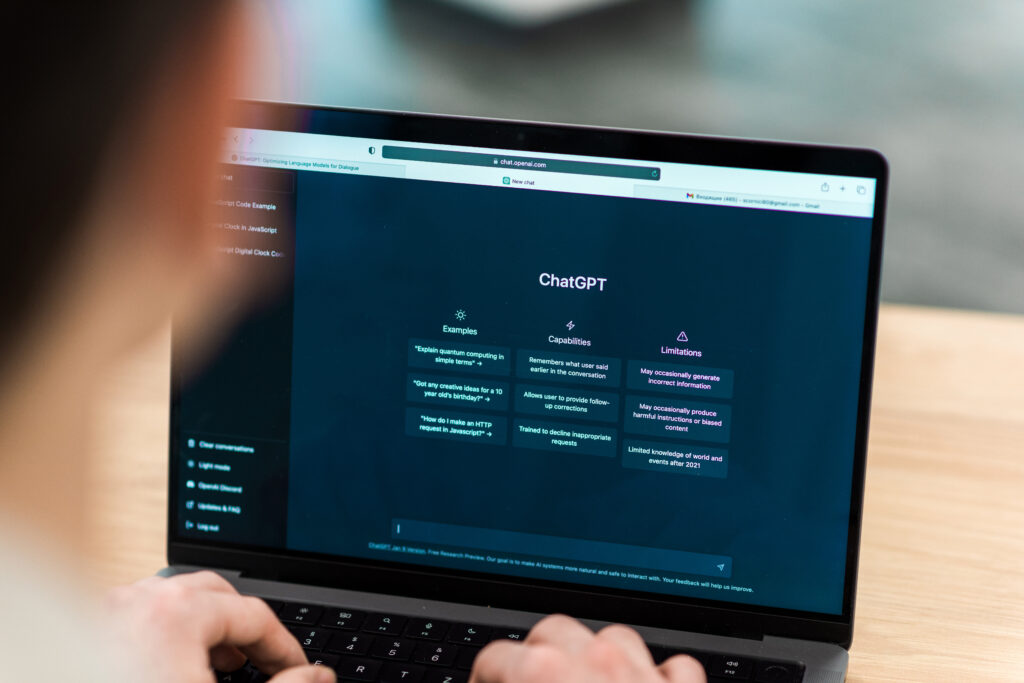
Image: Close view of a person with opened AI chat on laptop.
The keyword here is “conversational.” ChatGPT excels at back-and-forth dialogue where you’re exploring ideas, drafting content, or getting information. Need to write a customer email but struggling with the tone? ChatGPT can draft multiple versions in seconds. Want to brainstorm marketing campaign ideas? It’ll generate twenty options while you finish your coffee. Trying to understand a complex concept? It can explain it at whatever level of detail you need.
However, ChatGPT has essential limitations that many beginners don’t realize. It can’t actually do anything beyond generating text in the chat window. It won’t send emails, update your spreadsheets, schedule appointments, or connect to your business systems. It’s purely conversational—beneficial for thinking and writing, but it stops at the keyboard. Every action you want to take based on its suggestions still requires you to copy, paste, and execute in other tools manually.
This is where many businesses get stuck. They start using ChatGPT, get excited about the possibilities, and then realize they’re spending hours copying AI-generated content into various systems, wondering why their efficiency hasn’t dramatically improved. Understanding this limitation is crucial for knowing when ChatGPT is the right tool and when you need something more capable.
Decoding AI Agents: Intelligence That Takes Action
AI agents represent the next evolution beyond conversational AI. While ChatGPT can tell you what to do, AI agents can actually do it for you. An agent combines the conversational understanding of tools like ChatGPT with the ability to take actions, access information from multiple sources, and complete tasks autonomously within defined parameters.
Image: Workflow showing an AI agent receiving requests, interacting with tools, completing tasks, and reporting results.
Think of the difference this way: if you ask ChatGPT, “What’s on my calendar tomorrow?”, it will tell you it can’t access your calendar. Ask an AI agent the same question, and it will actually check your Google Calendar, read your schedule, and tell you specifically what meetings you have. Even better, you could ask the agent, “Reschedule my 2 pm meeting to Thursday and send apologies to the attendees,” and it would actually make those changes and send those emails.
AI Customer Agents are transforming how businesses handle repetitive but judgment-based tasks. A customer service agent can read incoming support tickets, understand what customers are asking, check order status in your database, consult your return policy documents, and compose personalized responses—all without human intervention for straightforward requests. The agent only escalates to humans when situations require empathy, complex decision-making, or handling exceptions outside its instructions.
The technology enabling this is called “function calling” or “tool use.” You give the agent access to specific functions (like “send email,” “update CRM,” “check inventory”), and it decides when to use them based on its understanding of what you’re asking it to accomplish. This makes agents incredibly powerful but also requires a more sophisticated setup than just opening ChatGPT and typing. You’re essentially building a custom AI employee with specific responsibilities and access to particular systems.
See AI Agents in Action?
Discover how AI agents can qualify leads, answer customer questions, and handle routine tasks 24/7 without expanding your team.
Demystifying Automation: The Reliable Recipe Follower
Traditional automation is conceptually the simplest of these three technologies, though it can become technically complex in implementation. Automation follows predetermined rules and sequences without deviation. If this happens, then do that—every single time, exactly the same way. There’s no interpretation, no decision-making, no adapting to context. It’s digital consistency at its finest.
Consider a typical business automation: when a customer fills out your contact form, the automation captures that data, creates a new contact in your CRM, sends a welcome email with specific information, notifies your sales team in Slack, and creates a follow-up task scheduled for three days later. This sequence executes identically whether it’s the first customer or the thousandth, at 3am on Sunday or noon on Tuesday.
Business Area
Manual Process
Automated Solution
Sales
Copy lead info from forms to CRM manually
Form submission automatically creates CRM contact with tags
Finance
Download invoices, rename files, upload to accounting
Invoices automatically sync to accounting software with proper categorization
Customer Service
Forward support emails to appropriate team member
Emails automatically routed based on keywords and customer history
Marketing
Manually send follow-up emails after events
Attendees automatically enter email sequence with personalized content
Operations
Update multiple spreadsheets with same data
Data entry in one system automatically updates all connected sheets
Table: Automation Examples Across Business Functions.
The power of automation lies in its reliability and scalability. Once you build a workflow correctly, it never forgets a step, never gets tired, and handles one task or one thousand tasks with identical accuracy. This makes automation perfect for repetitive processes with clear logic where the same inputs should always produce the same outputs. Many businesses discover tremendous value by implementing 10 fundamental automations that eliminate hours of mundane work each week.
The limitation? Automation struggles with anything requiring judgment, interpretation, or handling unexpected variations. If a customer submits a form with incomplete information, the automation might fail or create a mess in your CRM. If an invoice arrives in an unexpected format, the automated categorization might misclassify it. Traditional automation needs humans to handle exceptions and edge cases that don’t fit the predetermined rules.
The Comparison You Actually Need: Which Technology Solves What
Now that you understand each technology individually, let’s address the practical question: which one should you use for your specific business challenges? The answer almost always depends on the nature of the task, not the complexity of your business or the size of your team.
Capability
ChatGPT
AI Agents
Automation
Understands natural language
✅ Excellent
✅ Excellent
❌ Requires structured input
Generates creative content
✅ Excellent
✅ Good
❌ Can only use templates
Takes action in business systems
❌ No
✅ Yes
✅ Yes
Handles unexpected variations
✅ Very good
✅ Good
❌ Struggles with exceptions
Works 24/7 without supervision
⚠️ Requires user input
✅ Yes
✅ Yes
Setup complexity
⭐ Very simple
⭐⭐⭐ Moderate
⭐⭐ Simple to moderate
Ongoing maintenance
None
⭐⭐ Regular monitoring
⭐⭐⭐ Updates when systems change
Cost structure
Subscription ($20/mo)
Usage-based (variable)
Per-execution or flat rate
Best for…
Thinking, writing, exploring
Judgment-based repetitive tasks
Rule-based repetitive tasks
Table: Comparison of manual business processes versus automated solutions across sales, finance, customer service, marketing, and operations.
Use ChatGPT when you need help with cognitive work that ends with you taking action elsewhere. Writing, brainstorming, analyzing, explaining, summarizing—these are ChatGPT’s sweet spot. It’s perfect for one-off tasks or situations where you need intelligence but not execution. The business owner drafting a difficult client email, the marketer exploring campaign concepts, or the manager trying to understand a complex report all benefit enormously from ChatGPT without needing anything more sophisticated.
Choose AI agents when tasks require both understanding and action, especially when dealing with unstructured input from customers or team members. Customer support, lead qualification, document processing, and personalized communication all benefit from agents that can interpret intent, access necessary information, and complete appropriate actions. Our LeadQualify Agent demonstrates this perfectly—engaging prospects in natural conversation while automatically qualifying them and routing promising leads to your sales team.
Deploy automation when you have repetitive processes with clear steps and predictable inputs. Data synchronization, report generation, notification systems, and workflow triggers all work beautifully with traditional automation. If you can describe the process as “when X happens, always do Y, then Z,” automation delivers reliable, cost-effective execution. The key is ensuring your processes are actually standardized—trying to automate chaotic or inconsistent workflows usually creates more problems than it solves.
The Beginner’s Biggest Mistake (And How to Avoid It)
After working with hundreds of businesses implementing AI and automation, we’ve identified the single most common mistake beginners make: trying to force the wrong technology onto their problem. Someone hears about AI, gets excited, and tries to make ChatGPT run their entire business. Or they invest in complex automation for tasks that actually require human judgment. The technology isn’t wrong—the application is incorrect.
The solution is surprisingly simple: start with your problem, not with the technology. Don’t ask “How can I use AI?” Instead, ask “What specific task is consuming disproportionate time and could be handled more efficiently?” Describe that task in detail, including what varies and what stays consistent, what requires judgment and what follows rules, what happens occasionally versus constantly.
Once you’ve clearly defined the problem, the right technology often becomes obvious. Does it require creative or interpretive thinking but no actual execution? That’s ChatGPT territory. Does it need both understanding and action, especially with unpredictable inputs? Consider AI agents. Is it a repetitive process with consistent steps and clear logic? Traditional automation wins. Many scenarios benefit from combining multiple technologies, where businesses often find they need guidance from experts who understand how these pieces fit together.
Another critical mistake is expecting perfection immediately. Your first automation will probably have bugs. Your first AI agent will occasionally misunderstand instructions. ChatGPT will sometimes generate content that misses the mark. This is normal. Technology implementation is iterative—you start simple, learn from what doesn’t work, refine your approach, and gradually expand to more sophisticated applications. The businesses that succeed with AI and automation are those that embrace this learning process rather than demanding flawless execution from day one.
Making Your First Move: Practical Next Steps for AI Beginners
If you’ve read this far, you’re probably wondering what specific action you should take next. The good news is that starting with AI and automation doesn’t require massive investment, complete business transformation, or technical expertise you don’t have. Begin with one small, contained project that solves a real problem and delivers measurable results within weeks, not months.
For most businesses, the ideal first project involves ChatGPT because it requires zero technical setup and costs just $20 monthly. Identify one writing or thinking task that consumes significant time—perhaps drafting client proposals, creating email responses, or analyzing customer feedback. Spend two weeks experimenting with ChatGPT for this specific task, learning how to prompt it effectively and where it adds genuine value. This builds your intuition for how AI thinks and where its limitations appear.
Once you’re comfortable with conversational AI, examine your repetitive processes to identify automation opportunities. Look for tasks you do the same way every time, especially those involving moving data between systems or triggering actions based on specific events. Many businesses discover enormous value from simple automations that connect their existing tools and eliminate manual data entry. Start with one workflow, prove the value, then expand systematically.
AI agents typically represent your third step rather than your first. After you understand both conversational AI and traditional automation, you’ll recognize situations where the two need to merge—where tasks require both intelligence and execution. This is when exploring AI customer agents or lead qualification systems makes sense. These implementations deliver remarkable ROI but benefit tremendously from the understanding you’ve developed through simpler projects first.
Moving Forward: Your AI and Automation Roadmap
Understanding the difference between ChatGPT, AI agents, and automation represents just the beginning of your journey, not the destination. The real value comes from strategically applying these technologies to eliminate friction in your operations, free your team from soul-crushing repetition, and create work capacity that actually moves your business forward.
The businesses seeing the strongest results don’t choose one technology and ignore the others. They build a technology stack where each tool handles what it does best. ChatGPT supports thinking and creativity. Automation ensures reliable execution of standardized processes. AI agents bridge the gap, bringing intelligence to tasks that require both understanding and action. This integrated approach transforms operations more effectively than any single technology alone.
Remember that you’re not alone in feeling overwhelmed by these options. Every business leader navigating AI and automation faces the same confusion, encounters the same learning curve, and makes some of the same mistakes along the way. The difference between those who successfully transform their operations and those who abandon the effort usually comes down to starting small, learning continuously, and knowing when to seek guidance from people who’ve implemented these technologies dozens of times before. Your job isn’t to become an AI expert—it’s to recognize opportunities, make informed decisions, and focus on outcomes rather than technology for its own sake.
Archives for Category Archives: <span>Automation</span>
N8N vs OpenAI’s Agent Builder: Which Automation Platform Is Right for Your Business?
Maria Silva
9 min
Share
Share
The automation landscape has evolved dramatically in the past year. Business leaders now face a critical decision: should they invest in traditional workflow automation tools like N8N, or pivot to AI-native platforms like OpenAI’s Agent Builder? This choice isn’t just about technology preferences—it’s about choosing the foundation for your company’s operational future.
Both platforms promise to eliminate repetitive tasks and streamline operations, but they approach automation from fundamentally different angles. N8N offers visual workflow design with extensive integrations, while OpenAI’s Agent Builder leverages advanced AI reasoning to handle complex, dynamic tasks. Understanding which tool aligns with your business needs can save you months of implementation time and thousands in operational costs.
In this comparison, we’ll examine the strengths, limitations, and ideal use cases for both platforms, helping you make an informed decision that transforms chaos into flow.
Understanding the Core Philosophy Behind Each Platform
N8N and OpenAI’s Agent Builder represent two distinct generations of automation thinking. N8N emerged from the workflow automation era, where the primary goal was to connect disparate systems through predetermined sequences. It’s a visual, node-based platform where you design workflows by dragging and dropping components, creating a flowchart that executes specific actions when triggered. This approach offers transparency and control—you can see exactly what happens at each step, making it excellent for debugging and auditing.
Image: Conceptual side-by-side comparison of N8N and OpenAI Agent Builder on two laptops.
OpenAI’s Agent Builder takes an entirely different approach, rooted in autonomous intelligence. Rather than following rigid pathways, agents use large language models to interpret instructions, make decisions, and adapt their behavior based on context. You don’t design every step; instead, you define goals and parameters, allowing the AI to determine the best approach. This flexibility makes it powerful for tasks that involve interpretation, judgment, or dealing with unpredictable inputs.
The philosophical difference matters more than you might think. N8N excels when you need predictable, repeatable processes with clear logic. OpenAI’s Agent Builder shines when tasks require understanding nuance, adapting to variations, or processing unstructured information. Many businesses discover they need both approaches, using traditional workflow automation for structured processes while deploying AI customer agents for tasks requiring intelligence and adaptability.
Technical Capabilities and Integration Ecosystem
When evaluating automation platforms, integration depth determines what you can actually accomplish. N8N boasts an impressive library of over 400 pre-built integrations covering everything from mainstream tools like Slack and Google Workspace to specialized platforms like Airtable and WooCommerce. Each integration includes multiple actions and triggers, giving you granular control over how systems communicate. The platform also supports custom API connections, webhooks, and even allows you to write JavaScript or Python code directly within workflows when pre-built options aren’t sufficient.
Feature
N8N
OpenAI Agent Builder
Pre-built Integrations
400+ native integrations
Limited, relies on function calling
Custom API Support
Full REST/GraphQL support
Function-based API calls
Data Transformation
Visual mapping + code nodes
Natural language processing
Error Handling
Built-in retry logic, branching
Context-aware error recovery
Learning Curve
Moderate, visual interface
Lower initial, higher for optimization
Cost Structure
Self-hosted free, cloud paid
Token-based usage pricing
Table: Comparative table highlighting the technical capabilities and integration ecosystems of N8N and OpenAI’s Agent Builder.
OpenAI’s Agent Builder takes a different approach to integration. Rather than native connectors, it uses function calling to interact with external systems. You define functions that describe available actions (like “send email” or “update CRM record”), and the agent decides when to invoke them based on its understanding of the task. This creates more flexible, conversational interfaces but requires more technical setup. You’re essentially building a custom API layer that the agent can access, which gives enormous flexibility but demands stronger development capabilities.
For businesses already using multiple SaaS tools, N8N’s extensive integration library often provides faster initial value. You can connect everything across your tech stack without writing extensive code. However, suppose your workflows involve processing customer inquiries, analyzing sentiment, or making judgment calls based on unstructured data. In that case, OpenAI’s natural language understanding capabilities offer functionality that traditional automation simply cannot match.
Ready to Choose the Right Automation Platform?
Get a free audit of your current processes and discover whether traditional workflow automation, AI agents, or a hybrid approach will deliver the fastest ROI for your business.
Understanding abstract capabilities matters less than knowing what each platform actually accomplishes in practice. N8N particularly excels at operational automation where logic follows clear rules. Consider a digital agency managing client onboarding: N8N can automatically create project folders in Google Drive when deals close in CRM, generate contracts from templates, send welcome emails with scheduling links, and create tasks in project management tools. The entire sequence executes reliably every time because the logic never changes, similar to how we helped transform client onboarding workflows for one agency.
Image: Professional exploring AI agent workflows on a computer screen.
OpenAI’s Agent Builder demonstrates its value when context and interpretation become critical. A customer support agent built on the platform can understand nuanced complaints, check order status across multiple systems, determine appropriate refund amounts based on policy documents, and compose personalized responses that match brand voice. Traditional automation would require dozens of conditional branches to handle variations; the AI agent adapts naturally to each unique situation.
The distinction becomes even clearer around maintenance requirements. N8N workflows need updates when integrated systems change their APIs or when business rules evolve. Someone must manually modify the workflow, test changes, and redeploy. OpenAI agents can often adapt to minor changes through updated instructions without code modifications. However, agents require ongoing monitoring to ensure they interpret instructions correctly and don’t develop unexpected behaviors as they encounter new scenarios.
Cost Considerations and Strategic Decision-Making
Pricing models for these platforms differ so fundamentally that direct comparisons become challenging. N8N offers a self-hosted option that’s completely free if you have the technical infrastructure and expertise to deploy and maintain it. You’ll pay for server resources, but there’s no licensing fee. Their cloud offering starts at reasonable monthly rates but scales with workflow executions, making costs predictable based on automation volume.
OpenAI’s Agent Builder uses token-based pricing tied to the GPT-4 model powering the agents. Every input processed and response generated consumes tokens, making costs variable based on conversation length, complexity, and frequency. Light usage might cost under $100 monthly, but customer-facing agents handling thousands of inquiries could reach four or five figures. The unpredictability creates budgeting challenges, though costs typically correlate with value delivered.
Usage Scenario
N8N (Cloud)
OpenAI Agent Builder
Small Business (1,000 executions/month)
$20-50/month
$50-200/month
Growing Company (10,000 executions/month)
$100-300/month
$300-800/month
Enterprise (100,000+ executions/month)
$500-2,000/month
$2,000-10,000/month
Table: Compartative of cost structures and usage scenarios for N8N cloud and OpenAI Agent Builder.
Hidden costs deserve equal attention. N8N requires someone with workflow design skills to build and maintain automations. If you don’t have this expertise in-house, you’ll need external consultants or a significant training investment. OpenAI agents demand different skills—prompt engineering, function design, and behavioral tuning—that may not exist in traditional IT teams. This is why many organizations explore fully managed automation services to bridge the expertise gap.
The total ownership calculation should factor in opportunity costs as well. How quickly can you deploy automations that deliver business value? How much manual work will they eliminate? A comprehensive approach to building an automation culture considers not just tool costs but the entire economic impact of transformation.
Making the Right Choice for Your Business Context
The decision between N8N and OpenAI’s Agent Builder shouldn’t be an either-or proposition for most organizations. The smartest automation strategies often employ both tools strategically. Use N8N for the backbone of your operations—connecting systems, moving data, triggering actions based on events, and ensuring reliable execution of routine processes. Deploy OpenAI agents where human-like understanding, flexibility, and communication add unique value.
Image: Conceptual graphic representing workflow automation and AI agent platforms.
Consider starting with N8N if your immediate needs involve connecting existing tools, automating data transfers, or eliminating manual steps in well-defined processes. The platform’s maturity, extensive integrations, and predictable costs make it ideal for building a solid automation foundation. You’ll see ROI quickly with workflows that save hours of repetitive work each week.
Choose OpenAI’s Agent Builder when your challenges involve unstructured data, customer communication, content generation, or tasks requiring contextual judgment. An AI agent that qualifies leads through natural conversations or analyzes customer feedback for sentiment patterns delivers value that traditional automation cannot replicate. The LeadQualify Agent approach demonstrates how AI-powered automation transforms customer engagement.
For most SMEs and growing companies, the winning strategy involves hybrid implementation. Start with quick wins using whichever platform addresses your most pressing pain points. Build confidence and capability with initial projects, then expand your automation portfolio strategically. Document what works, learn from what doesn’t, and continuously refine your approach based on real business outcomes rather than technology trends.
Moving Forward: Your Next Steps in the Automation Journey
Choosing between N8N and OpenAI’s Agent Builder ultimately depends on your specific business context, technical capabilities, and strategic objectives. Neither platform represents a universally superior choice—each excels in different scenarios. The most successful automation initiatives start with clear objectives and realistic expectations rather than technology-first thinking.
Begin by auditing your current processes to identify automation opportunities. Which tasks consume disproportionate time relative to their value? Where do bottlenecks slow down operations? What manual work frustrates your team most? The answers to these questions should guide your platform selection more than feature checklists or pricing comparisons. Tools exist to serve business outcomes, not the other way around.
Remember that automation is a journey, not a destination. Your first workflows won’t be perfect, and that’s completely normal. Start small, iterate quickly, and scale what works. Whether you choose N8N’s structured workflows, OpenAI’s intelligent agents, or a combination of both, the goal remains the same: transforming operational chaos into productive flow that lets your team focus on work that truly matters.
Transform Your Operations With Expert Guidance
Not sure where to start? Schedule a free consultation with our automation specialists to map your unique automation roadmap and identify the quickest path to measurable results.
Archives for Category Archives: <span>Automation</span>
How to Identify Automation Requirements in Your Company: A Strategic Guide to Getting Started with AI
Maria Silva
11 min
Share
Share
Most businesses know they should automate, but few know where to start. The challenge isn’t the technology itself, but understanding which processes genuinely need automation and which ones don’t. Without a straightforward requirements identification process, companies often automate the wrong things, waste resources on low-impact projects, or create solutions that nobody uses.
The good news is that identifying automation requirements doesn’t require a technical background or a massive consulting budget. It requires a systematic approach to understanding your operations, listening to your team, and prioritizing based on real business impact. Whether you’re a small business owner wearing multiple hats or an operations manager at a growing company, this guide will walk you through the practical steps to identify where AI automation can transform your business from chaos to flow.
In this article, you’ll learn how to audit your current processes, engage stakeholders effectively, prioritize automation opportunities, and build a requirement’s framework that sets your automation initiatives up for success from day one.
Quick Answer: To identify automation requirements, follow these five steps:
Audit current processes to find repetitive, time-consuming tasks
Interview stakeholders to understand pain points
Score opportunities based on frequency, time consumption, and business impact
Document requirements with clear success metrics
Prioritize using a “quick wins first” approach balanced with strategic initiatives.
Why Requirements Identification Makes or Breaks Automation Success
Before diving into tools and technologies, understand why proper requirements identification is the key to the difference between automation success and failure. When you correctly identify requirements, you create a roadmap that aligns automation initiatives with actual business needs rather than perceived ones. This means your team adopts solutions enthusiastically because they solve real pain points, your ROI becomes measurable and significant, and your automation projects have clear success criteria from the start.
Poor requirements identification leads to scope creep, underutilized systems, and automation that creates more work instead of eliminating it. Rushing into automation without proper requirements carries significant hidden costs. Beyond wasted development time and licensing fees, poorly planned automation creates organizational skepticism, making future initiatives harder to launch. When an automation project fails or delivers minimal value, teams become resistant to subsequent attempts.
The requirements identification phase is also where you build organizational buy-in. When team members see that automation decisions are based on their input and genuine operational challenges, resistance decreases dramatically. This collaborative approach transforms automation from something that’s “done to” employees into something that’s “built with” them. Understanding how to build an automation culture starts with involving people in this crucial discovery phase.
Before diving into tools and technologies, you need to understand why proper requirements identification is the key to automation success or failure. Many businesses jump straight to implementing solutions without truly understanding what they’re solving for, leading to expensive mistakes and disappointed teams.
When you correctly identify requirements, you create a roadmap that aligns automation initiatives with actual business needs rather than perceived ones. This means your team adopts the solutions enthusiastically because they solve real pain points, your ROI becomes measurable and significant, and your automation projects have clear success criteria from the start. Poor requirements identification, on the other hand, leads to scope creep, underutilized systems, and automation that creates more work instead of eliminating it.
The requirements identification phase is also where you build organizational buy-in. When team members see that automation decisions are based on their input and genuine operational challenges, resistance decreases dramatically. This collaborative approach transforms automation from something that’s “done to” employees into something that’s “built with” them.
Starting with a Focused Process Audit
Your first step in identifying automation requirements is conducting a focused audit of your existing processes. This doesn’t mean documenting every single task in your organization, but rather mapping out the core workflows that drive your business operations. Focus on methods that are repeated regularly, involve multiple steps or people, and have a direct impact on customer satisfaction or revenue.
Begin by selecting three to five major operational areas to examine: customer onboarding, sales pipeline management, financial reporting, customer support, or inventory management. For each area, document the current state by mapping out the steps involved, identifying who performs each task, noting how long each step typically takes, and capturing where handoffs or approvals create delays. This process mapping reveals bottlenecks, redundancies, and manual tasks that consume disproportionate amounts of time.
Pay special attention to “swivel chair” processes where employees manually transfer data between systems. These are prime automation candidates because they’re time-consuming, error-prone, and genuinely frustrating. Look for processes where your team uses spreadsheets as workarounds, sends multiple follow-up emails to get information, or performs duplicate data entry in various places. Companies that have successfully implemented business integration solutions often start by identifying these disconnected workflows during their initial audit.
Common Swivel Chair Processes by Department
Department
Swivel Chair Process
Manual Time
Time Savings
Annual Hours Saved*
Sales
Copying lead info from forms into CRM
10-15 min/lead
90%
260-390 hours
Marketing
Transferring campaign leads to CRM
20-30 min/campaign
95%
400-600 hours
Finance
Copying invoice details into accounting software
8-12 min/invoice
90%
320-480 hours
Customer Support
Creating tickets from emails manually
5-7 min/ticket
90%
450-630 hours
Operations
Transferring orders to fulfillment systems
6-10 min/order
95%
570-950 hours
HR
Entering new employee data across systems
45-90 min/employee
70%
52-105 hours
*Annual hours saved calculated for small to mid-size business (50-200 employees)
Get Clarity on Your Automation Potential
Unsure where automation will have the biggest impact? Our free audit analyzes your operations and identifies your top three automation opportunities with estimated ROI.
Gathering Requirements from the People Who Know Best
The best automation requirements don’t come from management consultants or technology vendors, they come from the people who perform the work every day. Your employees have intimate knowledge of process inefficiencies, workarounds they’ve created, and frustrations that slow them down. The challenge is creating an environment where they feel comfortable sharing this information honestly.
Start by conducting structured interviews with team members across different departments and seniority levels. Ask open-ended questions like “What task do you wish you never had to do again?” or “Where do you spend time that doesn’t feel productive?” These conversations reveal requirements that would never appear in a formal process document because they’re part of the daily reality of getting work done.
The quality of your requirements depends heavily on the questions you ask. Avoid yes/no questions or leading questions. Instead, use questions that encourage storytelling: “Walk me through what you did yesterday between 2pm and 5pm” or “Tell me about the last time this process didn’t work as expected.” Pay attention not just to what people say, but to the emotion behind their responses. When someone becomes animated while describing a particular pain point, you’ve likely identified a high-priority automation opportunity.
Create safe spaces for honest feedback by emphasizing that automation is about eliminating tedious work, not eliminating jobs. Frame the conversation around freeing people to focus on higher-value activities they find more engaging. When employees understand that automation is designed to make their work more satisfying rather than replace them, they become enthusiastic contributors to the requirements gathering process.
Image: People in a meeting discussing project priorities.
Scoring and Prioritizing Automation Opportunities
Not all processes are created equal when it comes to automation potential. The goal isn’t to automate everything, but to automate the right things that deliver measurable business value. Evaluate each potential automation candidate against four key criteria: frequency, time consumption, error rate, and business criticality.
Frequency matters because processes that happen daily or weekly deliver compounding returns when automated. A task that takes 30 minutes daily consumes 130 hours annually. Time consumption helps you calculate direct ROI by understanding how much capacity you’ll free up. Error rate is crucial because manual processes involving data entry or calculations are prone to mistakes that create downstream problems. Business criticality ensures you prioritize automations that directly impact customer satisfaction, revenue generation, or compliance requirements.
Create a simple scoring matrix to evaluate opportunities objectively. Assign each criterion a score from 1-5, then multiply by weighting factors that reflect your business priorities.
For example:
Frequency (1-5) × 2, Time Consumption (1-5) × 2, Error Rate (1-5) × 1.5, Business Criticality (1-5) × 1.5.
A process that scores high across all dimensions would receive a total score of 35, while a low-priority process might score 10 or below. Set a threshold score of around 20-25 for initial projects. Learning from real success stories can help you understand how other businesses prioritized their automation initiatives effectively.
Turn Requirements into Results
Have your automation requirements documented but not sure how to implement them? Our team specializes in translating business needs into intelligent automation solutions that actually work.
Once you’ve identified high-priority automation opportunities, document requirements in a structured way that guides successful implementation. Good requirements documentation balances being detailed enough to guide development while remaining flexible enough to adapt as you learn more.
For each automation opportunity, create a requirements document that includes: process description, current state challenges, desired future state, success metrics, user roles and permissions, integration points with existing systems, and any compliance or security considerations. The process description should be clear enough that someone unfamiliar with your operations could understand what happens.
Success metrics are perhaps the most important element because they define how you’ll measure whether the automation delivers value. Avoid vague goals like “improve efficiency” in favor of specific, measurable targets such as “reduce invoice processing time from 45 minutes to 5 minutes per invoice” or “decrease customer onboarding errors from 12% to under 2%.” These concrete metrics make it possible to calculate ROI and demonstrate value to stakeholders.
Include both quantitative and qualitative success metrics. Quantitative metrics cover time savings, cost reduction, error rate improvement, and throughput increases. Qualitative metrics address user satisfaction, reduced frustration, improved customer experience, and better work-life balance for employees. For businesses looking to scale their automation efforts strategically, exploring fully managed automation services can help translate these requirements into working solutions.
Building Your Automation Roadmap
With documented requirements in hand, create a realistic implementation roadmap that sequences your automation projects strategically. The temptation is to tackle everything simultaneously or start with the most complex challenge, but both approaches typically lead to frustration and abandoned projects.
Instead, prioritize your automation initiatives using the “quick wins first” strategy combined with strategic importance. Quick wins are automations that deliver visible results quickly with relatively low implementation complexity. These early successes build organizational confidence, demonstrate value to skeptics, and create momentum for more ambitious projects. Look for automations that can be implemented in 2-4 weeks and deliver clear, measurable improvements that people across the organization will notice.
Examples of typical quick wins include automating email notifications when certain events occur, creating automated reports that previously required manual data compilation, or implementing simple chatbots that handle the most common customer questions. Balance these quick wins with strategically important projects that might take longer but deliver transformational value. A good automation roadmap typically includes 60% quick wins that build momentum and 40% strategic initiatives that drive significant business impact.
Consider dependencies between projects as well, since some automations create foundations that make subsequent projects easier.
For example:
Integrating your CRM with your email marketing platform might be a prerequisite for automating your lead qualification process effectively.
Create a visual roadmap that shows project timelines, dependencies, and expected outcomes.
Review and update it quarterly as you learn from completed projects and as business priorities evolve.
Image: Conceptual roadmap representing the journey of implementing automation.
Overcoming Common Requirements Challenges
Even with a structured approach, you’ll encounter challenges during requirements identification. One frequent challenge is the “we’ve always done it this way” mentality, where team members struggle to envision different ways of working. Combat this by showing examples from similar businesses or industries, not to copy their solutions but to expand thinking about what’s possible. Run small experiments or pilot programs that let people experience automation benefits firsthand before committing to large-scale implementation.
Conflicting requirements from different stakeholders can also create confusion, such as when the sales team wants automation that captures more lead information. In contrast, the marketing team prioritizes speed and simplicity; you need a framework for resolving these tensions. Facilitate conversations between stakeholders with competing requirements to ensure everyone understands the full context. Often, conflicts arise from assumptions about what’s technically possible or misunderstandings about other teams’ needs.
Technical uncertainty is another challenge, especially when you’re new to automation. You might wonder whether specific processes are even automatable or whether your existing systems can integrate. Set a clear deadline for the discovery phase, typically 2-4 weeks for small businesses and 6-8 weeks for larger organizations. Accept that you won’t have perfect information and that some requirements will need refinement during implementation. For complex technical questions, consider getting expert input through a free consultation to assess technical feasibility early.
Frequently Asked Questions
The biggest mistake is automating processes without first understanding why they exist or whether they should exist at all. Many companies automate inefficient processes, which simply makes bad processes run faster. Before identifying requirements for automation, question whether the process itself is necessary and whether it could be redesigned more efficiently.
What’s the biggest mistake companies make when identifying automation requirements?
The biggest mistake is automating processes without first understanding why they exist or whether they should exist at all. Many companies automate inefficient processes, which simply makes bad processes run faster. Before identifying requirements for automation, question whether the process itself is necessary and whether it could be redesigned more efficiently.
Archives for Category Archives: <span>Automation</span>
The CEO’s 90-Day Automation ROI Plan
Maria Silva
17 min
Share
Share
Every CEO faces the same dilemma when considering automation: how quickly can we see real returns, and is the investment truly worth it? The pressure to demonstrate value to boards, investors, and stakeholders makes long implementation timelines unacceptable. You need results, and you need them fast. The good news is that intelligent automation doesn’t require years of implementation to deliver measurable ROI. With the right approach, you can transform critical business operations and see tangible returns within just 90 days.
This comprehensive plan breaks down exactly how to approach automation as a CEO, from identifying high-impact opportunities in your first 30 days to scaling successful implementations in your third month. Whether you’re leading a growing SME, managing a SaaS startup, or steering an established enterprise, this roadmap will help you navigate the automation journey with confidence. The focus isn’t on implementing technology for technology’s sake, but on driving measurable business outcomes that directly impact your bottom line.
The traditional approach to digital transformation often involves lengthy consulting engagements, complex requirements gathering, and multi-year rollouts. This plan takes a different approach: rapid identification, quick wins, and iterative improvement. By the end of 90 days, you’ll have concrete data on time saved, costs reduced, and efficiency gained, giving you the evidence you need to make informed decisions about scaling your automation efforts across the organization.
Days 1-30: Assessment and Quick Win Identification
The first month is about strategic discovery and building momentum. Your primary goal is to identify the processes that are bleeding time and money from your organization while simultaneously finding opportunities for quick wins that will build confidence in your automation initiative. This phase requires honest assessment of your current operations and the willingness to look beyond how things have always been done.
Begin by conducting a comprehensive process audit across your organization. Work with department heads to identify repetitive tasks that consume significant employee hours but add little strategic value. Common culprits include data entry between systems, report generation, invoice processing, lead qualification, and customer onboarding workflows. Don’t just rely on leadership perspectives; talk to the people doing the work daily. They often have the most accurate picture of where bottlenecks occur and which processes cause the most frustration.
Image: Conceptual graphic representing analysis of manual process costs.
Calculate the true cost of manual processes by multiplying the time spent on each task by the fully loaded cost of the employees performing it. Most CEOs are shocked to discover that seemingly small inefficiencies, when multiplied across teams and months, represent six-figure annual costs. A finance team spending 15 hours weekly on manual data reconciliation doesn’t just cost those 15 hours; it costs the strategic work that team could be doing instead. This opportunity cost is often more significant than the direct labor cost.
Within your first 30 days, identify three to five processes that meet specific criteria: high frequency (performed daily or weekly), high labor intensity (consuming multiple hours per week), low complexity (following predictable rules), and high error rates (prone to human mistakes). These processes are your ideal automation candidates because they deliver quick wins that build organizational confidence. One example might be automating your lead qualification process, allowing your sales team to focus on closing deals rather than sorting through unqualified prospects.
Ready to Identify Your Automation Opportunities?
Get your complimentary business audit and discover exactly where automation can deliver the fastest ROI for your organization. Our experts will analyze your processes and provide a custom roadmap.
Days 31-60: Implementation of Foundation Automations
Month two is where strategy meets execution. You’ve identified your opportunities; now it’s time to implement your foundation automations and start generating measurable results. The key during this phase is to maintain focus on your identified quick wins rather than getting distracted by more complex projects that could derail your timeline.
Start with the highest-impact, lowest-complexity process from your assessment. For many businesses, this is often something in the sales or customer service domain. Implementing an AI customer agent for initial customer inquiries, for example, can immediately free up your support team while improving response times from hours to seconds. The beauty of starting with customer-facing automation is that the ROI is visible not just internally but to your clients as well, creating a positive feedback loop.
Your implementation approach should follow a clear methodology: map the current process in detail, identify decision points and data flows, build the automation in a test environment, validate with actual data, and deploy with monitoring. Don’t aim for perfection in your first iteration. An automation that handles 80% of cases and routes the remaining 20% to human oversight is infinitely better than no automation at all. You can refine and improve as you gather real-world data on performance.
Week
Activity
Key Deliverables
Success Metrics
5-6
Process mapping and workflow design
Detailed process documentation, automation architecture
Stakeholder sign-off on design
7-8
Automation build and integration
Working automation in test environment
100% test case coverage
9
User acceptance testing and refinement
Validated automation with real scenarios
<5% error rate in testing
10
Deployment and monitoring
Live automation with performance dashboard
Daily monitoring reports
Table: Foundation Automation Implementation Timeline
During implementation, establish clear performance baselines before your automation goes live. Measure exactly how long the manual process takes, how many errors occur, and what the cost per transaction is. Without these baseline metrics, you won’t be able to demonstrate ROI convincingly. Many organizations discover during this measurement phase that their manual processes are even more inefficient than initially estimated, making the ROI case even stronger.
Communication is critical during month two. Keep stakeholders updated on progress, celebrate small wins, and be transparent about challenges. The employees whose work is being automated may feel threatened, so emphasize how automation will eliminate tedious tasks and allow them to focus on more interesting, strategic work. Share stories from companies like the restaurant group that automated their financial processes and used the saved time to focus on growth initiatives rather than spreadsheet management.
Consider implementing fully managed automation for your initial projects if your team lacks automation expertise. This approach allows you to see results quickly without the learning curve and infrastructure investment required for in-house development. You can always transition to internal management once you’ve proven the value and built internal capabilities.
Need Expert Implementation Support?
Our automation specialists can implement your foundation automations in weeks, not months. We handle the technical complexity while you focus on running your business.
Days 61-75: Measurement, Optimization and ROI Calculation
By day 61, your foundation automations should be live and generating data. Now comes the critical phase of measurement and optimization where you transform that data into compelling ROI narratives. This is where many automation initiatives falter, either by failing to measure properly or by not communicating results effectively to key stakeholders.
Start by calculating your direct ROI using a simple formula: (Time Saved × Hourly Cost) + Error Reduction Value – Implementation Cost. For a customer service automation that handles 200 inquiries daily, previously taking an average of 10 minutes each, you’ve saved approximately 33 hours daily. At a fully loaded cost of $40 per hour, that’s $1,320 in daily savings, or approximately $343,200 annually. Even with a $50,000 implementation cost, your ROI is extraordinary, and you’ll break even in less than two weeks.
However, direct cost savings tell only part of the story. Measure secondary benefits that often deliver even more value: improved customer satisfaction scores, faster response times, increased employee satisfaction (as measured by surveys), reduced error rates, and increased capacity for strategic work. A sales team that previously spent 15 hours weekly on lead qualification can now spend that time on actual selling, potentially increasing revenue by far more than the cost savings alone would suggest.
Image: Professional reviewing key business metrics on a dashboard.
Create a comprehensive ROI dashboard that you can share with your board and leadership team. Include both quantitative metrics (hours saved, costs reduced, transactions processed) and qualitative benefits (employee testimonials, customer feedback, strategic capacity gained). Visualization is powerful; a graph showing the before-and-after state of a process is far more compelling than a spreadsheet of numbers. Show the downward trend of manual processing times, the upward trend of customer satisfaction, and the flat line of error rates that previously spiked regularly.
During this measurement period, identify optimization opportunities. Your automation likely handles common scenarios well but struggles with edge cases. Analyze the cases that still require human intervention and determine which ones could be automated with minor enhancements. This continuous improvement mindset is what separates good automation implementations from great ones. Every week, your automation should become slightly more capable and handle a higher percentage of cases automatically.
Don’t ignore the less tangible benefits. Talk to the employees whose work has been transformed by automation. Many report feeling less stressed, more engaged, and more valuable to the organization when they’re freed from repetitive tasks. This improvement in employee experience reduces turnover, improves productivity, and creates advocates for further automation within your organization. These advocates will be crucial as you move into the scaling phase.
Days 76-90: Scaling Strategy and Building Your Automation Culture
The final two weeks of your 90-day plan focus on strategic scaling and cultural transformation. You’ve proven that automation works, demonstrated clear ROI, and built organizational confidence. Now you need to transform those initial wins into a sustainable automation program that continues delivering value long after day 90.
Develop a 12-month automation roadmap based on what you’ve learned. Prioritize your remaining opportunities using a simple scoring system that considers potential ROI, implementation complexity, and strategic importance. Some processes might deliver enormous ROI but require complex integration with legacy systems, making them medium-term projects. Others might be quick wins similar to your initial implementations. Building an automation culture requires balancing quick wins that maintain momentum with larger transformational projects that deliver step-change improvements.
Establish governance structures for your automation program. Create a cross-functional automation council with representatives from IT, operations, finance, and key business units. This council should meet regularly to review automation performance, approve new automation initiatives, and ensure that automation efforts align with broader business strategy. Without proper governance, automation efforts become fragmented, with different departments implementing incompatible solutions that create new silos rather than breaking them down.
Image: Conceptual diagram showing automation governance structure and team roles.
Invest in building internal automation capabilities. While external partners can accelerate your initial implementations, long-term success requires internal expertise. Identify employees who have shown interest and aptitude during your first 90 days and invest in their training. Many of the tools used in modern business automation, from no-code platforms to AI agents, don’t require traditional programming skills. Your most valuable automation experts are often business users who understand processes deeply and can learn the technical tools, not IT professionals trying to understand business context.
Consider how business integration will play into your scaling strategy. Your initial automations likely operated within a single system or between two systems. As you scale, you’ll need to automate more complex workflows that span multiple systems, departments, and even external partners. Planning your integration architecture now will prevent technical debt later. Some organizations find that implementing a proper integration platform in the fourth or fifth month unlocks automation possibilities that were previously impossible due to system silos.
Document your success stories rigorously. When stakeholders question future automation investments, you need concrete evidence of past success. Create case studies that detail the problem, solution, implementation process, and results for each automation. These internal case studies serve multiple purposes: they provide templates for future similar projects, they celebrate wins and build momentum, and they create a knowledge base for new team members joining your automation program. Companies that excel at automation treat this documentation as seriously as they treat the automation itself.
Building Your Financial Case: ROI Metrics That Matter to Boards and Investors
When presenting your automation ROI to boards and investors, you need to speak their language and focus on metrics they care about. While operational improvements matter to you and your team, financial stakeholders want to understand how automation impacts revenue, profitability, and competitive positioning. Your 90-day results need to be framed in terms that resonate with this audience.
Start with the most straightforward metric: cost savings as a percentage of revenue. If your organization has $10 million in annual revenue and your initial automations are saving $350,000 annually, you’ve improved your cost structure by 3.5%. For many businesses, especially in competitive markets with thin margins, a 3.5% improvement in cost structure is transformational. Frame it in terms of what that percentage means: increased profitability, ability to reduce prices and win more business, or capacity to invest in growth initiatives without increasing headcount proportionally.
Beyond direct cost savings, calculate your automation ROI multiple times.
If you invested $75,000 in your first 90 days (including external expertise, internal labor, and technology costs) and you’re generating $350,000 in annual savings, your first-year ROI multiple is 4.7x. More importantly, unlike many business investments, automation continues delivering returns year after year with minimal ongoing costs. Your three-year ROI multiple might be 12x or higher. Few business investments can match these returns.
Investment Category
Cost
Annual Return
3-Year ROI
External automation expertise
$30,000
N/A
N/A
Internal labor (estimated)
$25,000
N/A
N/A
Technology and tools
$15,000
N/A
N/A
Training and change management
$5,000
N/A
N/A
Total Investment
$75,000
N/A
N/A
Direct cost savings
N/A
$350,000
$1,050,000
Revenue increase from capacity
N/A
$200,000
$600,000
Error reduction value
N/A
$50,000
$150,000
Total Return
N/A
$600,000
$1,800,000
Net ROI
N/A
700%
2,300%
Table: 90-Day Automation Investment vs. Returns Analysis
Don’t forget to quantify strategic value that might not appear on traditional financial statements. Automation often enables things that were previously impossible at any cost. A small team achieving enterprise-level results through automation can compete with much larger competitors, entering markets that would otherwise be closed to them. A company that can respond to customer inquiries in seconds rather than hours can win deals it would previously have lost. These competitive advantages are difficult to quantify precisely but are often more valuable than the direct cost savings.
Consider framing your automation success in terms of strategic optionality.
Your 90-day automation program hasn’t just saved money; it has given you options you didn’t have before. You can now scale operations without proportionally increasing headcount. You can enter new markets without building new operational infrastructure. You can test new business models with minimal operational risk. This strategic flexibility is invaluable in rapidly changing markets and should be part of your ROI narrative.
Finally, address the question every board will ask: what happens if we don’t automate? Calculate the opportunity cost of inaction. Your competitors are automating, and those who move quickly are building advantages that will compound over time. A company that starts automation today and achieves 20% operational efficiency gains has a sustainable cost advantage over competitors who delay. In three years, that advantage might be insurmountable. The ROI of automation isn’t just about the return you’ll achieve; it’s also about the competitive disadvantage you’ll avoid.
Common Pitfalls and How to Avoid Them in Your First 90 Days
Even with a solid plan, CEOs frequently encounter predictable obstacles during their first 90 days of automation. Being aware of these pitfalls allows you to avoid them or respond quickly when they emerge. The difference between automation success and failure often comes down to how you handle these challenges rather than avoiding them entirely.
The most common mistake is attempting too much too soon. The temptation when starting an automation program is to tackle your biggest, most complex problems first. After all, these are the processes causing the most pain and potentially offering the most significant ROI. However, complex automations require more time, more integration work, and more change management. They’re more likely to encounter unexpected obstacles that derail your timeline. Starting with simpler wins builds the skills, confidence, and political capital you need to tackle the complex challenges later.
Another frequent pitfall is underestimating change management requirements. You might build a perfect automation, but if the people who need to use it resist adoption, you won’t achieve your ROI. Involve process owners and end users early in your automation journey. Let them help identify problems and design solutions. When people feel ownership over automation initiatives rather than feeling like automation is being done to them, adoption rates soar. Schedule regular communication about automation progress, celebrate wins publicly, and address concerns transparently.
Image: Conceptual timeline showing key activities for successful automation adoption.
Many CEOs also fall into the trap of focusing exclusively on cost reduction while ignoring revenue opportunities. Yes, automation reduces costs, but it also enables growth. A sales team freed from administrative tasks can pursue more opportunities. A customer service team that resolves issues faster retains more customers. A product team that doesn’t spend time on manual reporting can ship features faster. Frame your automation program as a growth enabler, not just a cost-cutting initiative, and you’ll find more organizational enthusiasm and higher ultimate returns.
Technical debt is another hidden pitfall. In the rush to deliver quick wins, you might implement automations in ways that are difficult to maintain or scale. An automation that works perfectly for 100 transactions daily might break at 1,000 transactions daily. An integration that’s hardcoded for your current systems might require complete rebuilding when you upgrade software. Work with technical experts who can help you balance speed with sustainability, building automations that will serve you for years, not just months.
Finally, avoid the mistake of stopping measurement after initial implementation. Your automation ROI isn’t static; it evolves over time. An automation that saved 10 hours weekly in month one might save 15 hours weekly in month six as you optimize it and handle more edge cases automatically. Conversely, an automation that worked well initially might degrade over time if not properly maintained. Establish ongoing monitoring and continuous improvement processes from day one. The organizations that achieve the best long-term ROI from automation are those that treat it as a living program requiring ongoing attention, not a one-time project.
Your Next Steps: From 90-Day Plan to Long-Term Transformation
Your 90-day automation ROI plan is just the beginning of a longer transformation journey. The real value comes from building on your initial success and developing automation capabilities that become a core competitive advantage for your organization. The companies that thrive in the coming decades will be those that master the balance between human creativity and automated efficiency.
Start planning your next 90 days before your first 90 days end. By day 75, you should have clarity on which processes to tackle next based on your learnings. You’ll have a better understanding of your organization’s automation readiness, technical capabilities, and change management requirements. Use this knowledge to be more ambitious in quarter two while still maintaining realistic timelines. Many organizations find that their second quarter of automation delivers even better ROI than the first because they’re operating from a foundation of experience rather than starting from scratch.
Consider expanding your automation program beyond pure process automation. AI customer agents represent the next frontier, handling complex customer interactions that traditional automation can’t address. Predictive analytics can automate decision-making, not just task execution. Intelligent document processing can automate work that previously seemed too complex for automation. As your foundational automations mature, gradually incorporate these more sophisticated capabilities to maintain your competitive edge.
Invest in your people as much as your technology. The most successful automation programs are led by organizations that treat automation as a human capability, not just a technical one. Provide ongoing training, create career paths for automation specialists, and celebrate the individuals who drive automation success. Your ability to execute on automation opportunities is limited by your team’s capabilities, not by the available technology.
Remember that automation is a means to an end, not an end in itself. The goal isn’t to automate everything possible; it’s to free your organization to focus on what matters most. Keep asking yourself: what would we do with our time if this process were automated? If the answer is “find other busywork,” that’s probably not the right process to automate. Automate tasks that are preventing your team from delivering strategic value, serving customers better, or building the future of your business.
Your 90-day plan proves what’s possible. The next step is to make it permanent, integrate building automation into your organizational DNA, and create an operation that becomes more efficient, effective, and competitive with each passing quarter. The ROI you’ve demonstrated in these first 90 days is just the beginning of what’s possible when you commit to transformation.
Start Your 90-Day Transformation Today
Ready to prove the value of automation in your organization? Schedule a free consultation with our automation experts and get your customized 90-day ROI plan tailored to your specific business challenges.
Archives for Category Archives: <span>Automation</span>
Automation Playbook for Services Firms Under 50 People
Maria Silva
7 min
Share
Share
Running a small services company means every hour counts. You juggle sales, delivery, finance, and customer relationships—often with a team that’s already stretched thin. This playbook walks through practical automations that free up time, reduce stress, and keep clients happy, without turning your business into a science project.
Why Automation Matters for Small Teams
When you have fewer than 50 people, every manual process compounds inefficiency. Missed follow-ups, late invoices, and messy data don’t just waste time—they actively kill growth potential. A sales lead that sits unattended for three days is often a lost opportunity. An invoice sent two weeks late strains cash flow and sends the wrong signal to clients.
Automation gives small firms the same operational leverage that large companies enjoy, without adding headcount or complexity. The best part? You don’t need a dedicated IT department to get started. What you need is clarity about your processes, consistency in how you execute them, and a few tools configured correctly.
The firms that embrace smart automation early gain a critical advantage: they can scale revenue without proportionally scaling overhead. While competitors are drowning in administrative work, automated firms are focusing on delivery and growth.
Your sales funnel typically starts with a web form, chat interaction, or referral email. For most small firms, this is where leads fall through the cracks. Someone fills out a form at 9 PM on Friday, and by Monday morning, three other competitors have already responded.
Automating lead qualification can easily save 5-10 hours every week while dramatically improving response times.
The core workflow works like this: First, capture every lead in one centralized place, whether it comes from a contact form, live chat, or forwarded email. Next, automatically enrich that lead data with firmographic information like company size, industry, and location. Then route the lead to the right salesperson or account manager based on territory, expertise, or workload. Finally, trigger alerts when service level agreements slip—if a lead hasn’t been contacted within two hours, someone should know immediately.
A typical stack might include Fluent Forms for capture, n8n for orchestration, and your CRM as the system of record. The entire setup can be operational in an afternoon, and the time savings compound every single week.
2. Project Kickoff and Client Onboarding
Client onboarding is where first impressions are made and, unfortunately, often lost. A disorganized start creates anxiety and sets the wrong tone for the entire engagement. Conversely, a smooth onboarding process builds confidence and establishes your firm as professional and reliable.
Automate these critical touchpoints: Send a personalized welcome email with clear next steps and expectations. Generate contracts and initial invoices automatically based on the project scope. Create a complete task checklist in your project management tool—whether that’s ClickUp, Notion, or Asana—with deadlines, owners, and dependencies already mapped out. Schedule the kickoff meeting and send calendar invites to all stakeholders.
This automation transforms what used to be a two-hour manual process into a five-minute review-and-launch workflow. Your team can focus on building relationships rather than shuffling paperwork, and clients experience consistency regardless of who’s managing their account.
3. Finance and Collections
Chasing late payments is nobody’s favorite task, yet it’s critical for maintaining healthy cash flow. The problem with manual collection processes is that they’re inconsistent—some invoices get followed up diligently while others slip through unnoticed.
Set up trigger-based workflows to handle this systematically: When an invoice is sent, start a timer. After seven days, send a friendly automated reminder. If the invoice remains unpaid after 30 days, notify the account manager and escalate according to your policy. Throughout this process, sync payment status back to your CRM so the entire team has visibility into client account health.
Example workflow:
When invoice sent → wait 7 days → auto-reminder
If unpaid after 30 days → notify account manager and escalate
Sync payment status to CRM in real-time
Tools like Moloni or Stripe integrate well with workflow automation platforms like n8n, and you can route notifications to Slack for immediate visibility.
The result? Faster payments, fewer awkward conversations, and a finance process that scales without adding accounting staff.
See it in action: Check out our Case Studies to see real-world examples of finance automation implementations and the ROI they delivered
4. Reporting and Analytics
Every Monday morning, someone on your team spends hours compiling reports for client meetings or internal reviews. They pull data from Google Analytics, export figures from the CRM, check billing totals, format everything into slides, and send it out—only to repeat the process the following week.
This is exactly the kind of predictable, repetitive work that automation handles brilliantly.
Build a reporting automation that works while you sleep:
Fetch metrics from all your data sources—Google Analytics, CRM systems, billing tools, and project management software
Generate summaries in Google Slides, Notion pages, or PDF reports using templates you design once
Deliver updates automatically via email or Slack on a schedule that matches your review cadence—weekly for clients, monthly for board updates
The initial setup takes a few hours, but the ongoing time savings are enormous. More importantly, consistent reporting means you spot trends and problems earlier, when they’re easier to address.
Go deeper: Visit our Ebooks section for comprehensive guides on data-driven automation and building executive dashboards that actually get used.
Image: Person reviewing reports on a laptop, analyzing data from multiple sources.
5. Maintenance and Continuous Improvement
Here’s a truth that many automation guides skip: automation isn’t “set and forget.” Workflows break when APIs change, business requirements evolve, or edge cases emerge that weren’t considered during setup. The firms that get lasting value from automation are those that treat it as an ongoing system requiring regular care.
Establish a monthly review loop:
Log every run (success and failure) to build a performance baseline
Add alerts for broken steps so issues are detected immediately
Review “time saved” metrics quarterly to quantify ROI
Identify bottlenecks and prioritize which workflows deserve refinement
Documentation is critical here. When a workflow breaks at 3 AM because a vendor changed their API, you want clear documentation of how it’s supposed to work and where potential issues might hide. This practice also makes it easier to onboard new team members or work with external partners.
When to Get Help
There’s a tipping point where automation becomes a distraction rather than an asset. If you’re spending more time fixing workflows than delivering client work, you’ve crossed that line. This is when partnering with an automation specialist like Haipe Studio makes strategic sense.
Working with experts means you get:
Clean, documented workflows built with best practices from day one
Secure and compliant integrations that protect your data and your clients
Maintenance handled by experts who do this work full-time
Start with one high-impact workflow—either sales or finance—rather than trying to automate everything at once. Automate what’s predictable and working reasonably well, not what’s fundamentally broken. A bad process automated is just a faster way to create bad outcomes.
Review your automations monthly and invest in improvements quarterly. Document everything: the purpose, the logic, the edge cases, and the maintenance requirements. This documentation is what separates sustainable automation from technical debt.
Most importantly, remember that automation won’t replace your team. Instead, it gives them freedom to focus on the meaningful work that requires human judgment, creativity, and relationship-building. In a services firm under 50 people, that’s where your competitive advantage actually lives.
The firms that master this balance—leveraging automation for operational excellence while preserving human touch for client relationships—are the ones that punch above their weight and scale profitably without losing what made them special in the first place.